Whether you’re at home or on the go, keeping your insulin effective means storing it the right way:
Unopened insulin: • Keep in the refrigerator (36°F–46°F / 2°C–8°C) • Don’t freeze it! Frozen insulin must be discarded.
Opened insulin (in use): • Store at room temperature (below 86°F / 30°C) • Good for 28–42 days, depending on the type (check your insulin’s instructions) • Keep away from direct sunlight and heat
Avoid: • Leaving it in a hot car • Putting it directly on ice • Using after the expiration date
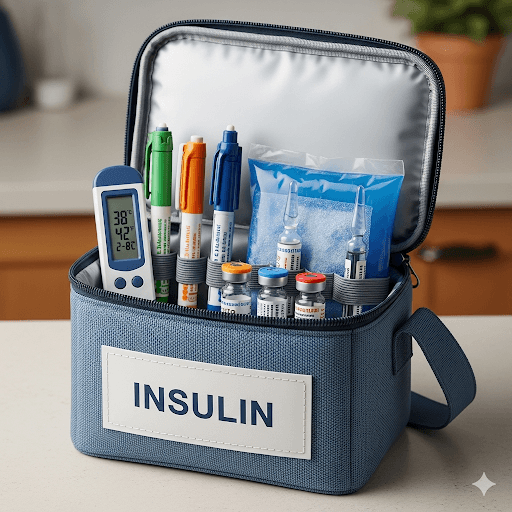
Travel tips: • Use aninsulated cooler (opens in a new tab), cooling case (opens in a new tab), or cooler (opens in a new tab) • Carry insulin with you in a carry-on, not checked luggage
Insulin + Heat = Trouble
Did you know that high temperatures can damage insulin?
When insulin is exposed to heat (above 86°F / 30°C), it can break down and lose effectiveness — even if it looks perfectly fine. This can lead to unexpected high blood sugar and poor glucose control.
Signs your insulin may be heat-damaged: • It’s been left in a hot car or direct sun • It looks cloudy (when it shouldn’t) or has clumps/particles • It’s past the recommended storage time at room temperature
What to do: • When in doubt, don’t use it — heat-damaged insulin is unsafe • Always store insulin in a cool, shaded place • Use insulated cooler (opens in a new tab), cooling cases (opens in a new tab), or cooler (opens in a new tab) during hot weather or travel
Never refrigerate insulin after it’s been heat-exposed — it won’t fix the damage.
How long can insulin be exposed to heat before it’s affected?
Room temp (below 86°F / 30°C): Insulin is safe for 28–42 days (depending on the brand) after opening.
Above 86°F / 30°C: Insulin can start to degrade within a few hours — especially if left in a hot car, direct sun, or outside during a heatwave.
Above 98.6°F / 37°C (body temp) or hotter: Damage may occur in under 1 hour. In extreme heat (over 100°F / 38°C), it can degrade in minutes.
Bottom line
If insulin has been exposed to heat above 86°F for more than 1–2 hours, especially in direct sunlight or a hot car, it’s safer to replace it — even if it looks normal.
Always carry insulin in a cool, insulated bag when outdoors or traveling. Check out our medical bag post and travel section for more!